Eventuri Toyota Supra GR 3.0 carbon intake system — EVE-A90-CF-INT | OKTAN.store
1 / 8
Specifications
Numer katalogowy producenta
EVE-A90-CF-INT
Marka pojazdu
Toyota
Model
Supra
Wersja
A90
Materiał
Włókno węglowe
Description
EVENTURI CARBON INDUCTION SYSTEM | TOYOTA SUPRA MK5 B58 3.0
Part number: EVE-A90-CF-INT
Gains: 17-20 HP, 15-27 Nm
*Some photos show the optional carbon engine cover, available separately.
The Eventuri intake system for the Supra MK5 model was created to ensure free flow of air to the turbine while maintaining its low temperature. The amount of air and its temperature are the main issues when creating intake systems for turbocharged engines. In the Supra model, the intake is located right next to the exhaust manifold, which rapidly heats the engine compartment. High temperatures limit engine performance because the turbine must generate boost with heated, rarefied air, so the only way to minimize temperature is to use a completely closed intake system. However, there is a problem here - because by default there is only one intake channel. During design work, Eventuri engineers noticed an extra hole in the wheel arch and made use of it by adding a second intake duct to the housing. Additionally, the intake is equipped with a heat shield with a gold layer insulating it from the influence of the exhaust manifold. To maximize the volume, the housing has been made the largest possible dimensions, as well as a special recess for possible spacers. The twisted factory inlet pipe has been replaced with a smoothed carbon element with a larger capacity and a starting diameter of 111 mm (4.4"), tapering gently to the size of the turbine inlet. The pipe ensures an unobstructed flow path from the filter to the turbine inlet. And finally - a specially developed, high-flow dry air filter with ISO certification for filtering efficiency, with a larger surface area than its production counterpart.
Dyno tests
The Eventuri intake was independently tested by an American tuning workshop on a model with a downpipe section and engine modification. The tests were performed one after the other on the same day - the only difference was the intake system - factory and Eveturi. As you can see in the charts, the performance increases in a wide range of revolutions, in some places the increase is up to 20 HP. This is the result of removing interference from the air path while maintaining low temperature thanks to the tight construction of the housing.
Dyno tests with the open cone filter will show gains with the hood up, but on the road with the hood down, thermal breakdown will contribute to a significant loss of power as the uncovered cone sucks in hot air - a big problem on the Supra as the intake system is located directly next to the exhaust manifold and turbine. A higher air temperature means its lower density, so the turbine is unable to generate the appropriate boost pressure and, as a result, the power drops. Moreover, while the vehicle is accelerating and the open cone filter has already drawn in the existing hot air, the turbine and engine will continue to heat the inside of the engine compartment and the filter will continue to suck air from it. A loaded engine during acceleration causes the turbines to release a lot of heat, which can be seen even with the naked eye because the sides become red hot. That's why Eventuri engineers decided on a fully tight structure.
Tests were also carried out in the UK by Evolve Automotive in a vehicle equipped with a downpipe section and a Stage 2 modification. The chart shows the differences between three variants: a completely stock version, a version with a downpipe section and a Stage 2 modification with a factory intake system, as well as a version with an Eventuri intake, a downpipe section and a Stage 2 modification. All tests were carried out with the hood closed.
The Eventuri intake system for the Supra MK5 model consists of several elements that fulfill precisely defined functions and are manufactured in accordance with the highest quality standards. Only prepreg carbon fiber is used without any glass fiber, which means a much smoother internal surface, guaranteeing free flow. Below you will find descriptions of individual components and an explanation of their operation.
Each intake system consists of the following components:
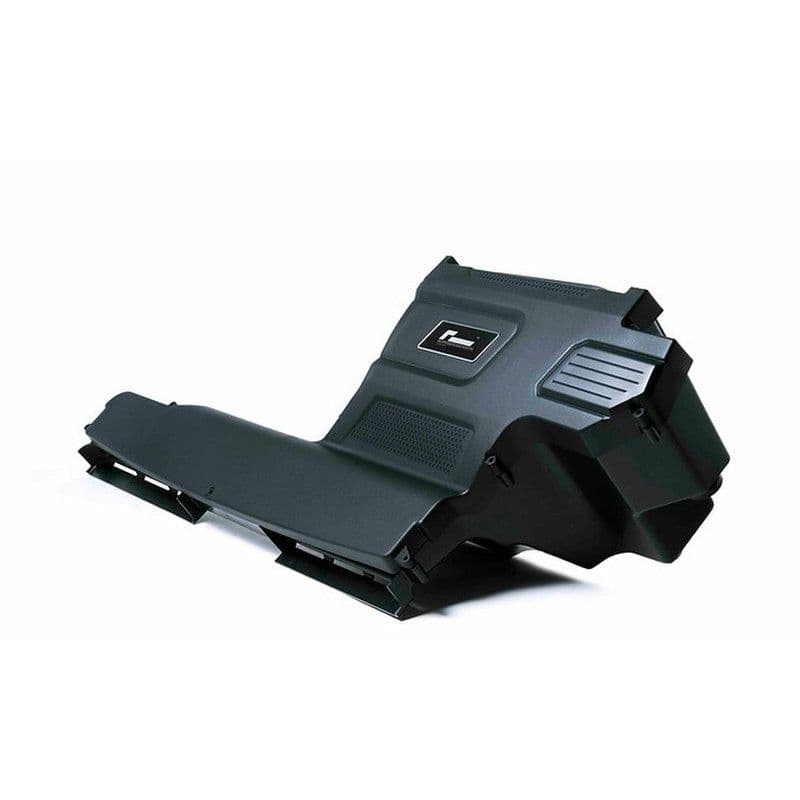
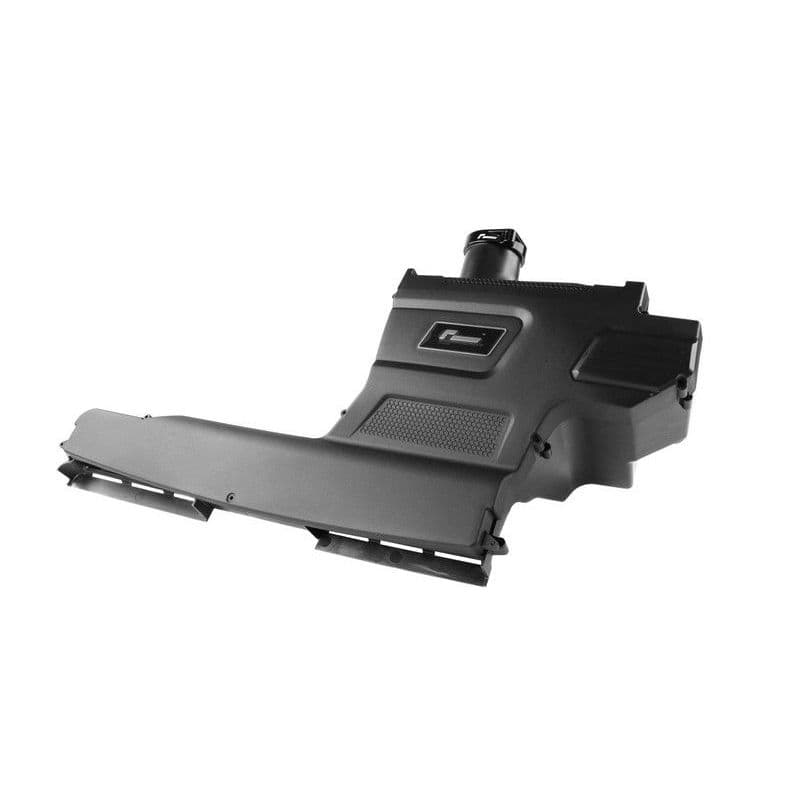
• patented carbon casing with two air inlets
• specially developed high-flow dry cone filter
• carbon inlet pipe
• milled holder for the temperature sensor
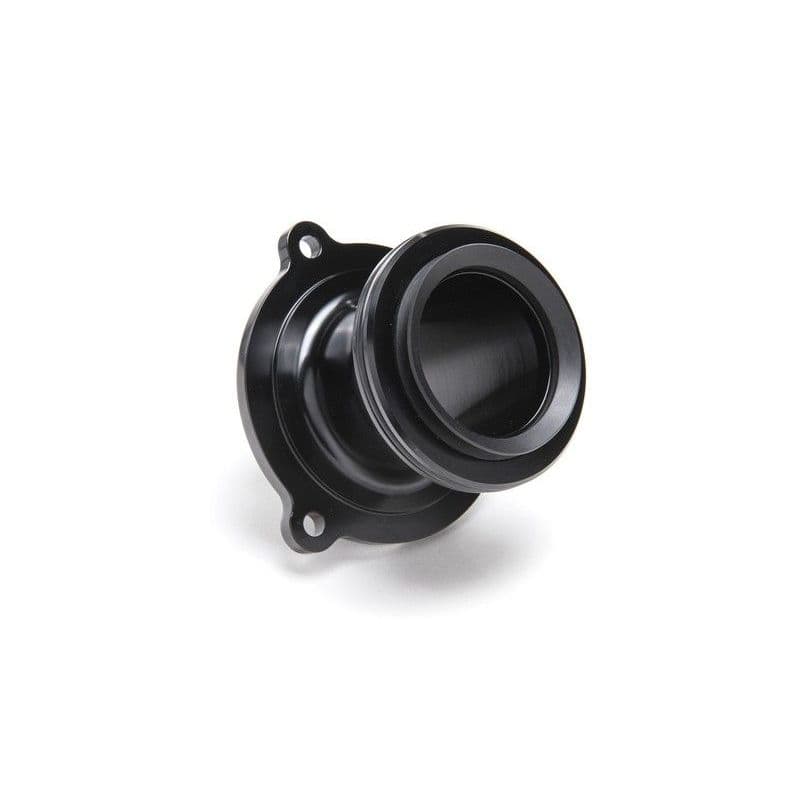
• milled adapter for the vent valve
• heat shield with gold insulating surface
• laser cut stainless steel handles
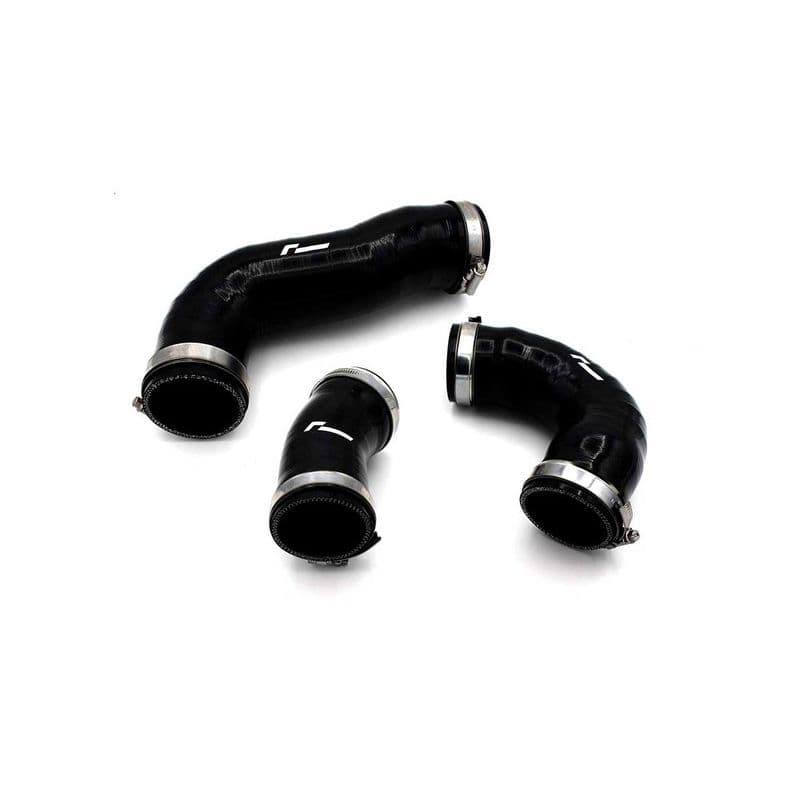
• silicone connector with clamps with factory parameters
Carbon housing with two inlets
The casing made of prepreg carbon fiber serves two purposes - it protects the filter against high temperature from the engine compartment and provides two sources of cold air. Since the housing is located right next to the exhaust manifold, it was necessary to use a closed design - the carbon housing shell forms a tight capsule for the filter, while ensuring large capacity. To ensure a tight seal in the intake pipe, Eventuri engineers designed a laser-cut plate with a rubber gasket that attaches to the housing. The pipe passes through the plate and a rubber gasket prevents hot air from entering the inside. To further reduce thermal breakdown, an additional thermal shield with a gold thermal insulation layer is used on the side of the exhaust manifold, which effectively reduces the impact of thermal radiation.
With a completely closed intake system, the problem of limited access of cold air must be solved. The factory intake sucks air from one channel, the inlet of which is located near the front bumper. While developing the structure, Eventuri engineers found another place from which cold air can be taken in - the gap between the wheel arch and the chassis element on which the filter housing is mounted. To take advantage of this, the rear intake has been extended to reach the wheel arch - after installation it is visible behind the front wheel. The additional inlet allows the turbine to draw air from a larger space, thus reducing flow restrictions. Due to the fact that the inlet reaches the wheel arch, there is internal protection against water that could get into the filter. The animation below shows both inlets and the internal water protection.
The final consideration regarding the housing was to accommodate its use in performance vehicles with an optional inlet mounted in the headlamp frame, used to obtain maximum cold air flow. There is a removable panel on the side of the housing, facing the headlight, so if an additional intake is fitted in place of the headlight, this panel can be removed to provide another intake duct to the filter.
Carbon inlet pipe
The factory inlet pipe has a tightly twisted flexible section, which is designed to eliminate the impact of engine movements. However, this solution promotes turbulence in the flow path because there are many places that can generate vortices. This element is replaced by a carbon tube with a smooth surface and greater capacity. Unlike products of competing brands, the Eventuri pipe is larger than the factory one - the diameter of the stock pipe at the filter outlet is 80.0mm/3.2", and Eventuri - 109mm/4.3" - this means that the cross-sectional area is as much as 82% larger. The pipe tapers gently to the stock turbine inlet to maintain the layered nature of the airflow. It also has milled entries for the temperature sensor and a venting system adapter.
Specially developed conical filter
The Eventuri conical filter is made of double-layer non-woven mesh material, ISO certified, which ensures the filtration rate is in line with the factory standard. This is a reusable product - it can be cleaned and reused. It is stable at high temperatures - the base material is urethane. The filter has an internal cone to help direct air in the right direction and prevent a stagnation point in the middle of the filter. The filter insert has a much larger surface area compared to the factory panel equivalent.