EVENTURI CARBON INTAKE SYSTEM MERCEDES C63 / C63S AMG W205
Product number: EVE-C63S-CF-INT
Performance gains - Stage 2: 22-30 HP, 27-32.5 Nm
Performance increases - series: 10-12 HP, 16-20 Nm
Data from the measuring station: factory intake 179 l/s, Eventuri 250 l/s (average for each housing)
Fits the following models: C63 C63S AMG W205 / S205 / C205 / A205
The Eventuri intake system for the Mercedes C63 AMG W205 is the culmination of intensive research and development work and numerous tests. Engineers set themselves 3 main goals:
1) Increased flow.
2) Low intake air temperatures.
3) Unobstructed flow of air flow. The first was achieved by using all available space in the C63S engine compartment, resulting in a 39% increase in flow compared to the factory equivalent; second - as a result of using a completely tight housing: the C63S engine compartment gets very hot due to, among others, on turbines located close to the intake system, so a tight design is crucial; and finally the third - as a result of the use of organic shapes with rounded panel filters, eliminating any sharp edges that could disrupt the smooth, layered air flow. Smooth transitions from filters to turbine inlets minimize turbulence, allowing turbochargers to operate more efficiently.
By achieving the above three goals, the Eventuri intake system for the C63S W205 performs well on all fronts and significantly contributes to more efficient turbo generation. This translates into better throttle response and clearly noticeable power gains, which increase with further stages of tuning. Since different turbines are available for the C63S, Eventuri engineers have created a special solution for the larger turbochargers. The intake for the C63S is available in two configurations with different internal diameters of the exhaust pipe: 61mm for factory and hybrid turbines, and 3" for larger aftermarket turbines.
Performance gains - Stage 2: 22-30 HP, 27-32.5 Nm
Performance increases - series: 10-12 HP, 16-20 Nm
Dyno tests were carried out both on a completely stock C63S and on a Stage 2 modified version with downpipe sections and a remapped engine controller. Below is a dynamometer graph for the Stage 2 version with the same modification in all tests - the only difference was the intake system. Importantly, the hood of the vehicle was closed during the measurements to better simulate road conditions. A raised hood, especially on open cone filter configurations, doesn't give a true picture of how changing the intake system affects power. When driving on the road, the hood is lowered and all the heat generated by the turbines is trapped in the engine compartment. This is why the use of a closed intake design is crucial in the C63S. Dyno tests using an uncovered filter with the hood up will show gains, but when driving in real conditions, performance will be significantly lower because a lot of hot air will enter the system. Higher air temperature reduces its density, so the turbines are unable to generate sufficient boost and, as a result, the power is lower. Moreover, when the vehicle accelerates and the open cone filters have already sucked in all the existing hot air, the engine and turbines generate further portions of heated gases, which also enter the intake system. The engine under load and during acceleration causes the turbines to emit a large amount of heat, which is noticeable even to the naked eye, because the hot sides of the turbocharger can become red hot.
Below you can see that in the case of a closed Eventuri intake, power increases linearly from 4800 rpm, where the air demand increases and the factory housings set limits. Gains were measured after replacing the stock housings with an Eventuri intake - all other modifications were retained when measured with the stock housings and Eventuri intake.
The increases measured on the dynamometer translate into better throttle response at partial and full opening, and the tachometer needle moves more quickly to the red zone. Tests were performed on the same day, one after the other, and temperatures were monitored to maintain consistency of results. The vehicle was first tested with the factory intake with the hood down. Then the Eventuri intake was installed and another test was performed - also with the hood lowered. Several tests were performed with both configurations to obtain a reliable result.
The following tests were performed on the Insoric road dynamometer, which measures driving performance. They were carried out by the CD Dynamics team in Germany on the same day on the same section of highway with an Eventuri intake and a factory equivalent installed. This particular C63S had a Stage 1 modification. As you can see, after exceeding 5,000 rpm and the engine's air demand increases, the factory housings create resistance, and the Eventuri intake allows for an increase of 31 HP and 39 Nm.
Flow tests
Eventuri engineers used the Superflow SF-1020 to measure the maximum possible flow at a pressure of 1.01 psi. The tests were performed on the same day under controlled conditions using the same measurement station for each system. The Eventuri closed intake system with a specially developed filter and the factory housings with the stock filter were tested, as well as the open intake system with a conical filter, equipped with a pipe of the same diameter as the factory turbine inlet. Elements on the left and right sides were tested.
The results clearly show how limiting the factory intake system is - Eventuri improves its results by up to 41% at the maximum possible flow. Interestingly, the open intake system, although it performs better than the factory equivalent, did not achieve a better result than the Eventuri. This happened because the diameter of the intake pipe is constant throughout the entire length from the turbine outlet to the cone filter. Eventuri significantly increases its capacity between the filter and the turbine outlet, and the open inlet maintains the same, small cross-sectional area. The difference is roughly the same as between sucking air through a straw and a funnel.
The Eventuri intake system for the C63S AMG consists of several elements that fulfill precisely defined functions and are manufactured in accordance with the highest quality standards. Below you will find descriptions of individual components and an explanation of their operation.
Each intake system consists of the following components:
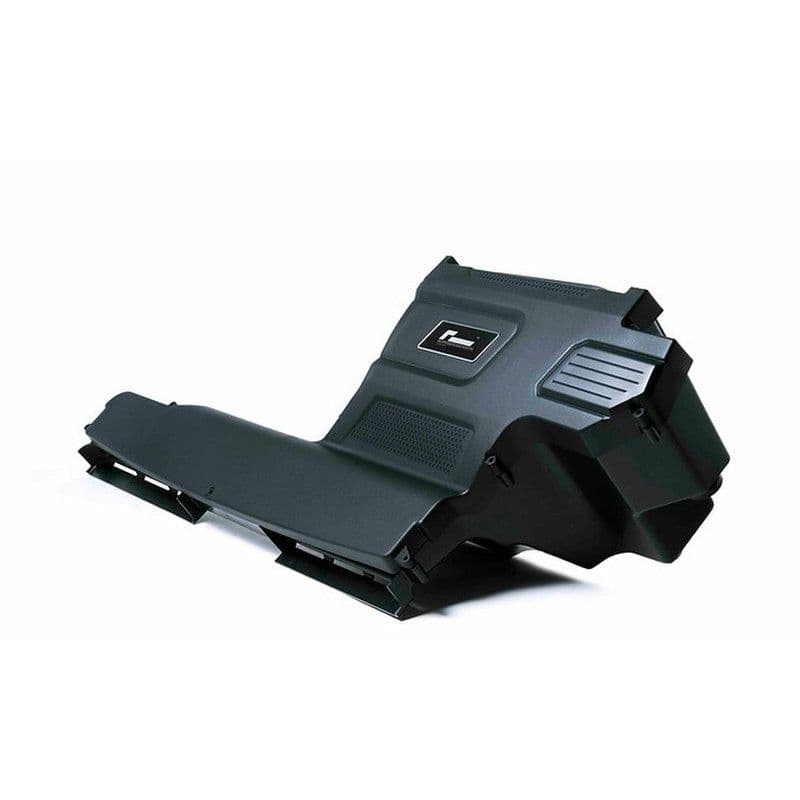
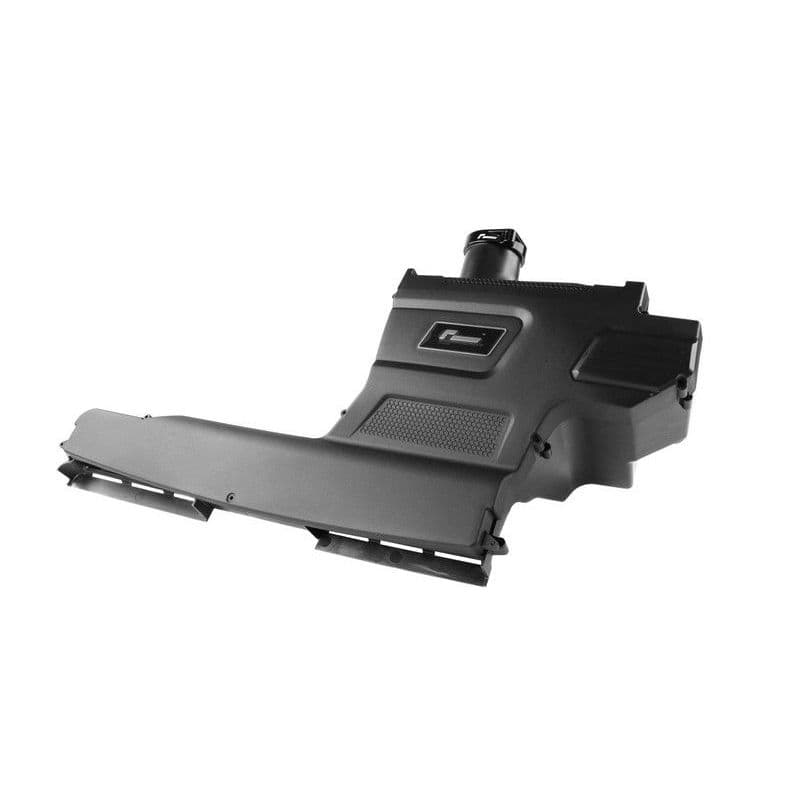
• 2 carbon covers with passage to the turbine inlet
• 2 carbon bases with passage to the inlet channels
• 2 carbon intake channels
• 2 specially developed high-flow panel filters
• 4 milled aluminum filter flanges
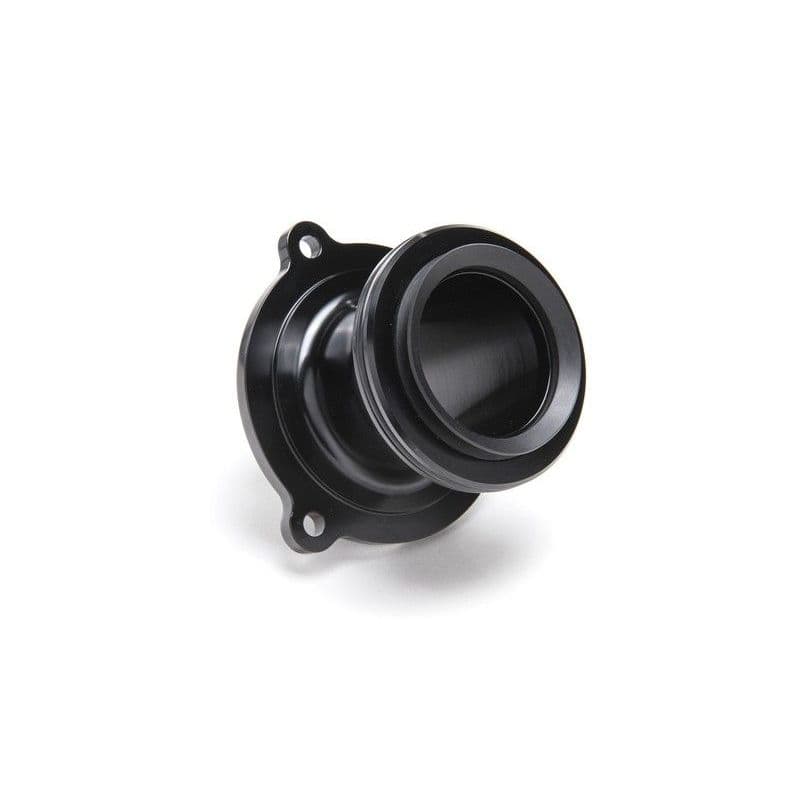
• 2 milled MAP sensor inputs
• 4 milled handles with rubber mounts
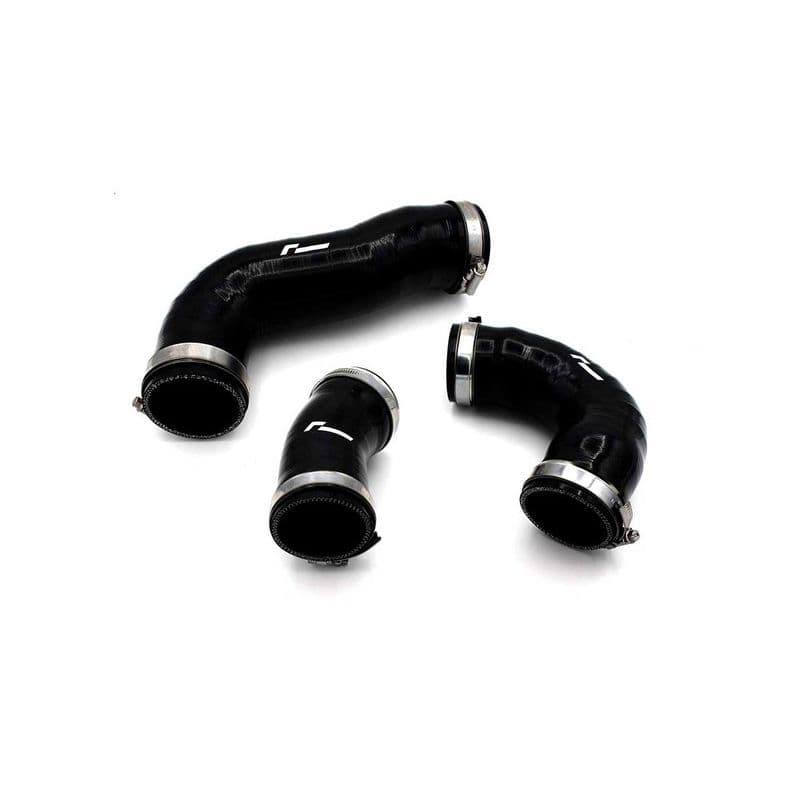
• 2 specially developed connectors made of EPDM rubber
• laser cut stainless steel handles
HOUSINGS
The housings consist of an upper and lower section, separated by a panel filter. Each section has been carefully designed for maximum volume while maintaining a smooth airflow path to the turbines. The biggest challenge was to increase the capacity of the housing to improve the flow rate compared to factory counterparts. Since the C63S engine compartment is very tight, this goal could be achieved by increasing the overall internal height of the housing. The best effect was obtained by increasing each cover. As you can clearly see, a significant increase in volume was achieved while maintaining smooth air flow.
SIDE PROFILE
Comparing the side profiles of the factory housing and the Eventuri equivalent, it is easy to notice that the original element has a limited airflow space after passing through the filter. The housing narrows to 23mm in height, while the Eventuri cover has a height of 56mm, which is 143% higher. A large part of the upper part of the stock housing is also taken up by the MAP sensor, which reduces the volume and increases the flow restriction. Eventuri engineers moved the sensors to the back of the cover, which allows full use of the space above the filters for free air flow. Another issue is the inlet of the housing base, which in the factory version has a flexible, twisted section with numerous bends and a height of 43 mm. Eventuri eliminates kinks and increases the height to 74 mm, providing a smoother path for the airflow.
FRONT PROFILE
The front view of the case clearly shows the limitations of the original item. The top section is only 23mm high in a large part of the lid, making the flow much more difficult. However, the Eventuri intake provides much more space right up to the turbine inlets. The inlet to the lower section has also been significantly enlarged in terms of cross-section - it is as much as 84% larger than the stock one.
SPECIALLY DESIGNED PANEL FILTERS
Eventuri engineers wanted to achieve optimal airflow, so they designed completely new panel filters with a double filtering layer and non-woven mesh, certified to ISO 5011. Additionally, the rounded outer profile instead of the traditional rectangular shape with sharp angles allowed for a smoother housing profile, devoid of sharp edges, which minimizes any airflow disruptions.
When you look at the base of the case, you can clearly see the difference between sharp and rounded angles.
MILLED FILTER FLANGES
The key issue when using panel filters is to ensure tight mounting in the housing. Due to the use of prepreg carbon fiber in the housing construction, it is not possible to rely on the relatively large tolerance of carbon compared to a precisely cut component. That's why Eventuri engineers developed single-bill milled aluminum and black anodized flanges that mount inside the housing. The flanges ensure a solid and tight connection around the rubber profiles of the filters.
CARBON FRONT INLET CHANNELS
Another element are carbon front intake channels, replacing previously used EPDM counterparts. They connect to the housing through EPDM connectors. Their shape ensures a smooth transition between the oval inlets on the front fascia and the filter housing, while maintaining maximum capacity.
MILLED MOUNTING BRACKETS
To keep the housings in place, the Eventuri intake uses factory rubber bushings. For additional security, Eventuria engineers have developed milled handles that firmly hold the entire structure exactly where it is needed.
Every design aspect has been considered with great attention to detail. The result is a true work of engineering art that serves as a benchmark for the design of intake systems for the C63S AMG.